TERMINALSat King Fahd International Airport, Dammam (DMM)
King Fahd International Airport has three separate terminals, and ordinary passengers use only one of them. The Main Terminal handles every scheduled domestic and international flight.
The Aramco Terminal is closed to the public. The Royal Terminal is closed to almost everybody.
The three terminals
The Main Terminal
This is the terminal every passenger means when they say Dammam Airport. It is a six-storey building of 327,000 square metres, and it handles domestic and international flights under one roof, with separate halls rather than separate buildings.
Saudia, Flynas and Flyadeal carry most of the domestic traffic. International carriers work the same terminal, with Dubai the busiest route on the board at around seventy flights a week. The full list of destinations, with the airlines on each one, is on the nonstop route table.
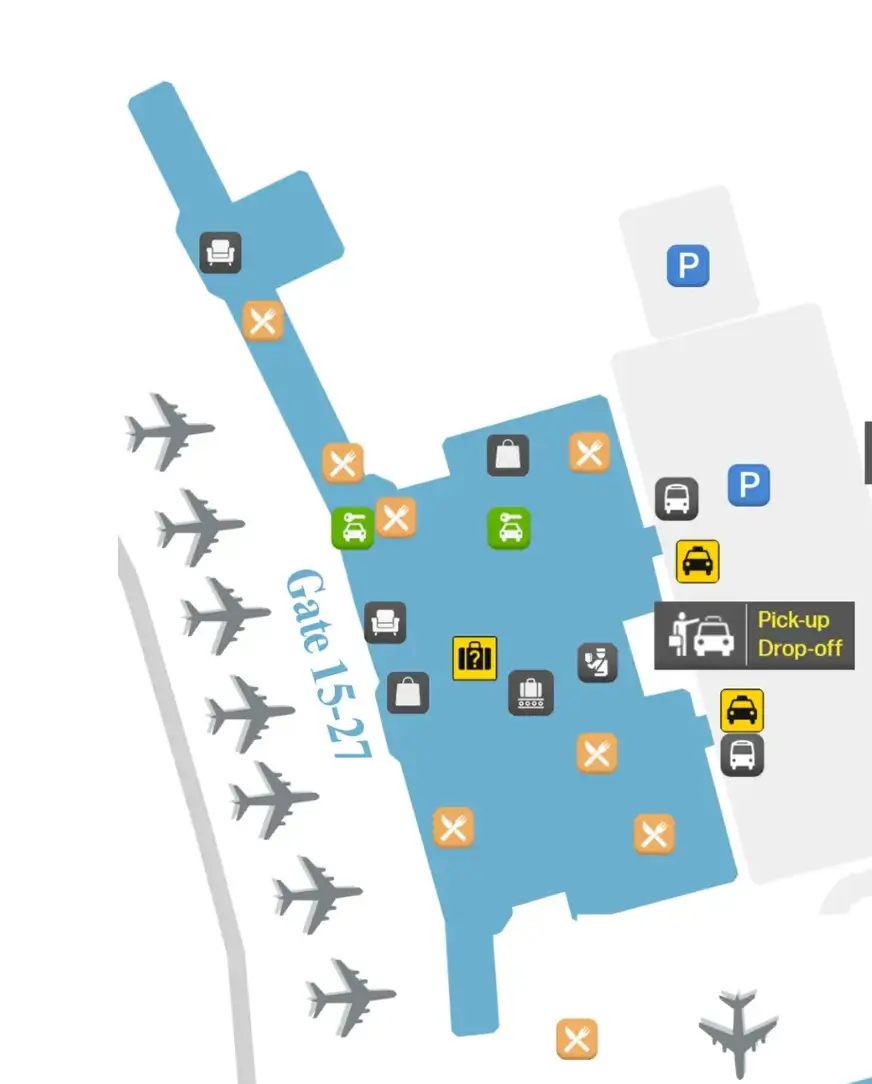
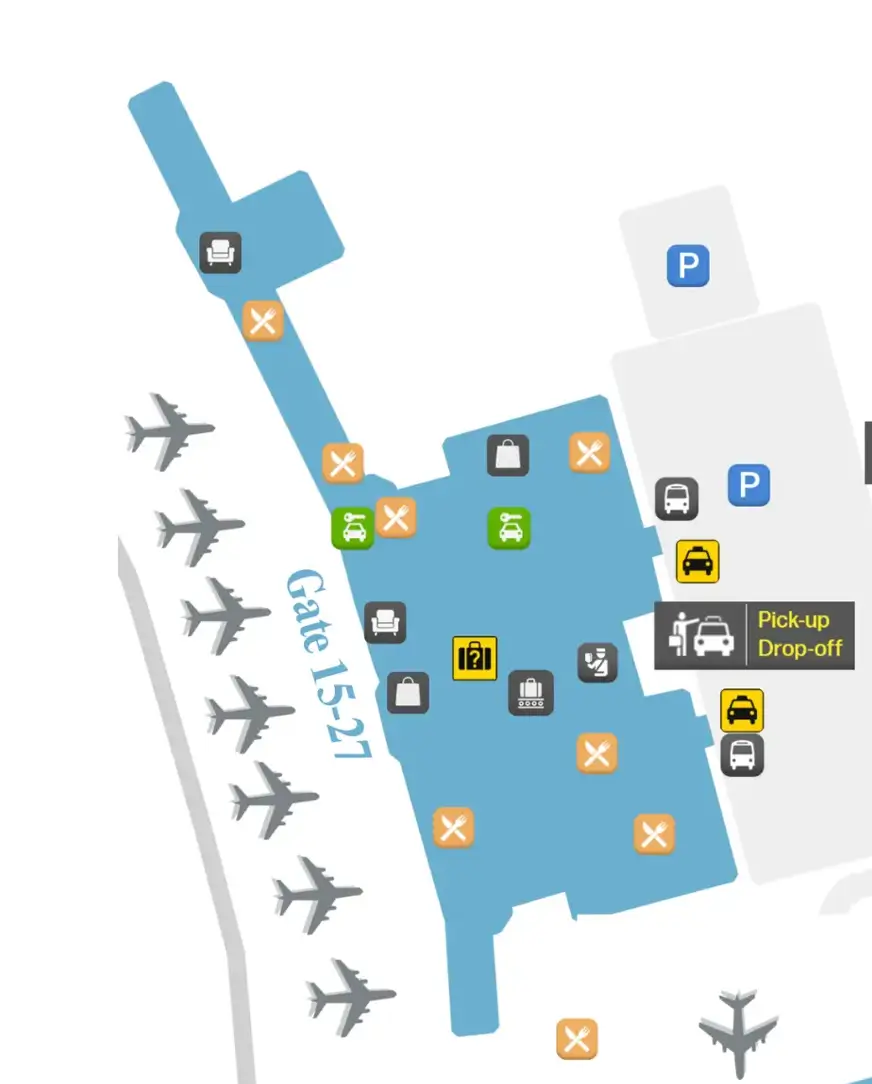
The map covers the departures concourse and the landside kerb. Gates 15 to 27 run along a single finger with aircraft parked on the apron beside it, and the icons mark the lounges, food outlets, shops, baggage reclaim belts, information desk and car hire counters along the way. On the landside edge, the pick-up and drop-off lane sits between the taxi ranks and the bus stops, with the car park behind them, which is the sequence to expect when you walk out of arrivals.
The full airport, including the aprons and both runways, is on the wider airport map.
The Aramco Terminal
Saudi Aramco runs its own air operation from its own terminal at King Fahd, and it is not open to the public.
The airline is Saudi Aramco Aviation, operating as Mukamalah. It exists to move Aramco employees and contractors between Dammam and the company’s remote sites: Yanbu on the Red Sea coast, Tanajib in the north east, and Shaybah deep in the Empty Quarter. These are places with no useful commercial service, which is why a private oil company ended up running a scheduled airline.
Two things follow from that, and both catch people out. You cannot buy a ticket on an Aramco flight, and arriving at the Aramco Terminal without a company badge or a sponsored booking will not get you airside. And a search for “Aramco airport” in the Eastern Province usually means King Fahd itself rather than the terminal, because locals have used the name for the whole airport for decades.
If you are flying Aramco, your departure point is the Aramco Terminal, not the Main Terminal, and the two are separate buildings on an enormous site. Confirm which one before you set off.
The Royal Terminal
Reserved for the Saudi royal family, senior government officials and visiting heads of state. It covers around 16,400 square metres and has four of its own boarding bridges.
It sees very little use. Its aircraft stands are counted among the airport’s thirty remote positions, which is the only way most passengers will ever encounter it: as a set of parked aircraft seen from a taxiway.
Inside the Main Terminal
The airport names its levels rather than numbering them, and the signage uses the same words: Arrival, Departure, Boarding, Mezzanine and Service. Directions below follow those names.
Eating, shopping and lounges
Food and coffee run around the clock, which is unusual for an airport this size, and the duty-free store operates on both the departures and the arrivals levels. The outlets, the queue to plan for and the arrivals purchase limits are set out in the guide to duty free and eating at the airport.
Four lounges operate here, two on the international side and two domestic, and access is sold at the door as well as through membership schemes.
Prayer rooms and the mosque
The mosque is not inside the terminal. It sits above the multistorey car park and holds around 2,000 worshippers, with enclosed air-conditioned walkways connecting it to the building, so reaching it does not mean going outside.
Inside the terminal there are prayer rooms on every level, each with ablution facilities, and they stay open around the clock. The airport publishes their exact positions as a layer on its own terminal map, which is worth using rather than a list, because the layout shifts with construction work.
Wi-Fi and phone service
Free Wi-Fi covers the terminal. The network is DAMMAM AIRPORT FREE WIFI and the password is DAMMAM123. It carries browsing and messaging; anything heavier is unreliable at a busy hour.
Telecom desks in the terminal sell local SIM cards and handle top-ups and roaming. For a stay of more than a day or two in the Eastern Province that is the steadier option.
Banks, ATMs and currency
Banks and cash machines appear as their own layer on the terminal map, and currency exchange counters sit landside. Alinma Bank is on the departure level, beside the Plaza Premium lounge.
If you are bringing cash rather than withdrawing it, the amount you may carry without declaring it is set by customs rather than by the airport.
Smoking
Smoking is confined to designated smoking rooms in the departures area. Nowhere else in the terminal allows it, and the same restriction covers vapes, because Saudi law treats nicotine e-cigarettes as tobacco products when deciding where they may be used.
The Plaza Premium lounge has a smoking room of its own.
Getting in and out
The covered car park connects to the terminal by walkway, and taxis, ride-hailing and SAPTCO buses all work the kerb outside. Arriving passengers clear passport control, collect bags, then pass customs into the arrivals hall.
Times on the board move. Check live arrivals before setting out to meet anyone.
Dammam Airport Code: DMM and OEDF
The IATA code for King Fahd International Airport is DMM. The ICAO code is OEDF.
DMM is the three-letter code on your ticket, your boarding pass and your baggage tags. OEDF is the four-letter code used in flight plans and by air traffic control, and it follows the regional pattern: OE for Saudi Arabia, DF for this airport. Passengers never need it, but it is what appears on tracking sites and in cockpit paperwork.
Frequently Asked Questions
How many terminals does Dammam Airport have?
Three, but only the Main Terminal is open to the public. Every scheduled domestic and international flight uses it. The other two belong to Saudi Aramco and to the royal family, and neither can be entered on an ordinary ticket.
Is there free Wi-Fi at Dammam Airport?
Yes, across the terminal. Join the network DAMMAM AIRPORT FREE WIFI and enter the password DAMMAM123. Telecom desks in the terminal also sell local SIM cards, which is the better option if you are staying in the region.
Does Dammam Airport have prayer rooms?
Yes, on every level, with ablution facilities and open around the clock. There is also a mosque holding about 2,000, reached by air-conditioned walkway from the terminal, which sits above the car park rather than inside the building.
Can you smoke at Dammam Airport?
Only in the designated smoking rooms in departures. The rest of the terminal is non-smoking, and vapes are treated the same way under Saudi law, so there is no separate allowance for them.
What is the airport code for Dammam?
DMM for tickets, boarding passes and baggage tags. OEDF is the ICAO code used in flight plans and by air traffic control, where OE stands for Saudi Arabia and DF for this airport specifically.
Can I fly from the Aramco Terminal?
Not unless Aramco is sending you. Saudi Aramco Aviation, trading as Mukamalah, carries employees and contractors to company sites at Yanbu, Tanajib and Shaybah. Tickets are not sold to the public and the terminal is a separate building from the Main Terminal.
Last reviewed: August 2026.